


A few years ago, the Texas Property Tax Reform and Transparency Act modernized how property taxes are communicated and adopted across the state. The law renamed key tax rate terms and required all taxing jurisdictions to publish their rates publicly each year.
Now, when politicians or local taxing entities discuss “rate hikes” or property tax changes, you’ll often hear two important terms, the No-New-Revenue Rate and the Voter-Approved Rate. But what do they actually mean?
These rates are published separately by each county and explained through the state’s Truth in Taxation process — a transparency system designed to show how local governments calculate and adopt their final tax rates each year.
Although your property tax bill only shows the adopted rate, understanding these two benchmark rates helps property owners see whether local entities are maintaining, increasing, or reducing their overall tax collections. That’s where confusion often begins and where clarity can make a major difference for property owners planning next year’s budget.
At Alamo Ad Valorem, we believe informed owners make better financial decisions. Here’s a breakdown of what these terms really mean and how they impact your bottom line.
The No-New-Revenue Tax Rate (NNR): The “Keep It the Same” Rate
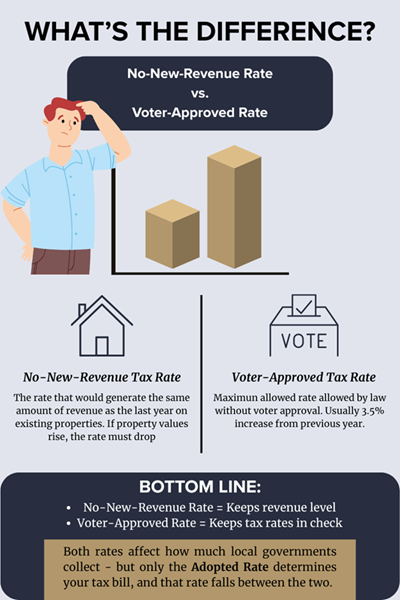
The No-New-Revenue Tax Rate, previously called the Effective Tax Rate, represents the rate a taxing unit would need to collect the same amount of total property tax revenue as the previous year, from properties that were on the roll both years.
If property values across the county rise, this rate will typically go down. That’s because the government would need a lower rate to collect the same total revenue.
In other words, it answers the question:
“What would the tax rate be if local governments collected the same amount of money as last year, without raising more?”
This rate is meant to provide transparency. It helps taxpayers see how much of a tax increase (or decrease) is being proposed due to changing property values, not including new construction.
The Voter-Approved Tax Rate (VAR): The “Maximum Without an Election” Rate
The Voter-Approved Tax Rate (formerly the Rollback Rate) is the highest rate a taxing unit can adopt without voter approval.
Most local governments in Texas can only raise maintenance and operations revenue by up to 3.5% over the previous year before triggering a voter-approval tax rate election. This safeguard ensures that if officials want to raise taxes beyond a modest amount, taxpayers get to decide.
So, while the No-New-Revenue Rate tells you what would “keep things the same,” the Voter-Approved Rate tells you how far local entities can go before you get a say at the ballot box.
The Adopted Tax Rate: The One That Actually Matters
When it comes to calculating your actual property tax bill, only one rate really counts, the Adopted Tax Rate. These adopted rates are published by the state comptroller here.
Each taxing entity (county, city, school district, etc.) holds public hearings and ultimately votes to adopt a final rate. This is the number applied directly to your taxable property value to determine your total taxes owed.
Your tax bill formula is simple:
Taxable Value ÷ 100 × Adopted Rate = Property Tax
Example:
If your property’s taxable value is $1,000,000 and your county adopts a rate of $0.435 per $100 of value, your county tax portion would be:
$1,000,000 ÷ 100 × 0.435 = $4,350
Add in your city, school district, and any special districts, and you’ll arrive at your total property tax bill.
Why This Matters for Property Owners
Understanding these three rates helps you read between the lines when tax notices arrive. A taxing unit may claim it “didn’t raise rates,” but if your property’s appraised value increased and the adopted rate stays the same (or even slightly below the voter-approved rate), your tax bill can still go up.
At Alamo Ad Valorem, we analyze these nuances every day to help commercial and residential property owners reduce over-assessed values and minimize property tax burdens across Texas. Knowing how these rates work is the first step in protecting your investment and cash flow.
Bottom Line
- No-New-Revenue Rate: Keeps revenue level, shows what rate maintains the same tax revenue.
- Voter-Approved Rate: Caps the increase before a public vote is required.
- Adopted Rate: The real rate used to calculate your tax bill.

Let Alamo Ad Valorem Help You Take Control
If your 2025 appraised value jumped or you’re unsure whether your tax rate is fair, our experienced team can help you review your assessment, identify discrepancies, and represent you through every step of the protest process, from informal hearings to formal appeals.
Contact us today to see how much you could save.
Visit www.alamoadvalorem.com or call (210) 952-4152 for a free property tax review.