


A successful Bexar County property tax protest usually comes down to one thing: the quality of the evidence.
Homeowners sometimes walk into a protest hearing with dozens of photographs, neighborhood listings and explanations of why they believe their property value is too high. But more evidence does not necessarily mean better evidence.
Texas appraisal review boards are expected to consider whether evidence is relevant and reliable. The Texas Comptroller’s ARB training material specifically emphasizes the quality, rather than simply the quantity, of the evidence presented.
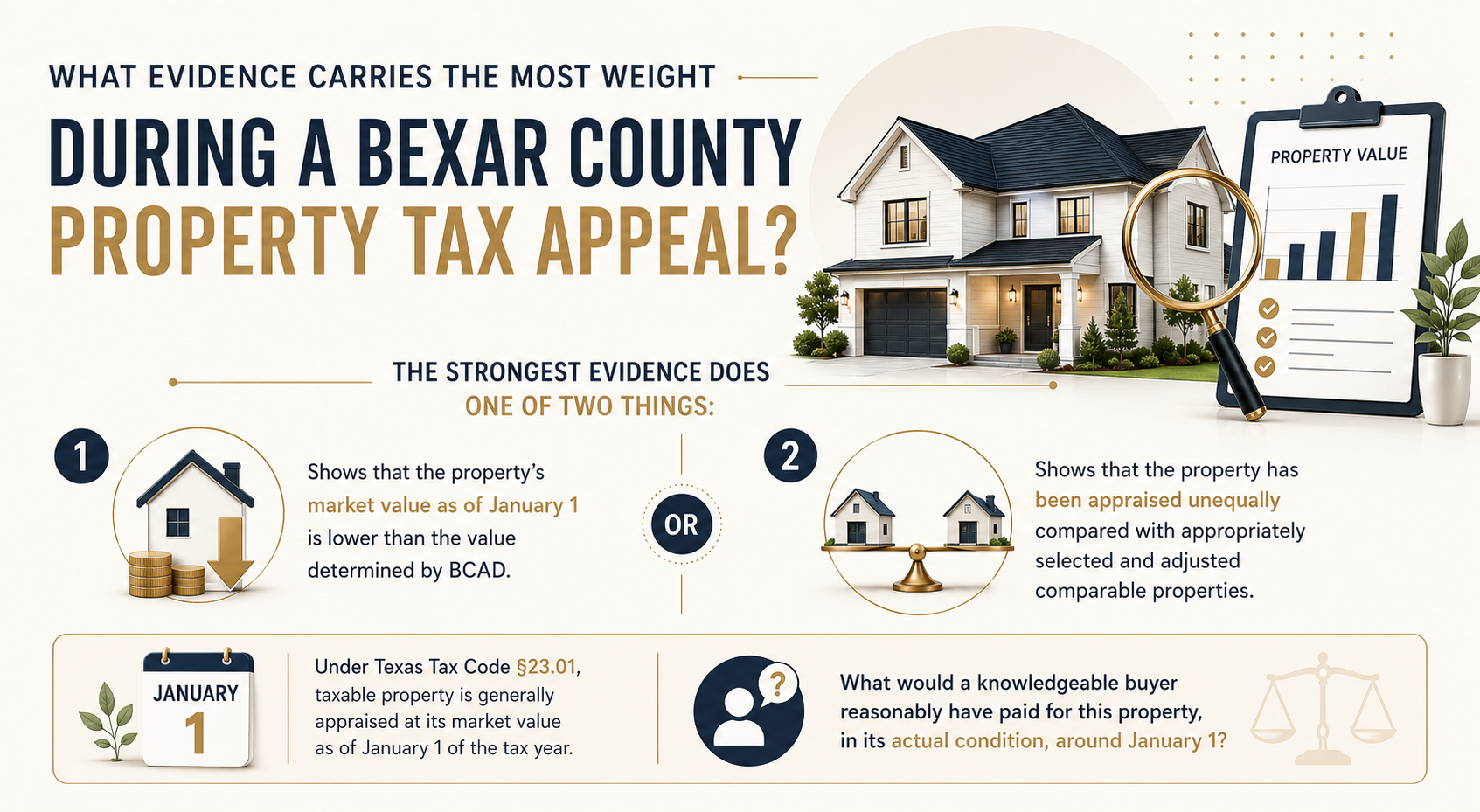
For a residential property owner in Bexar County, the strongest evidence generally does one of two things:
- Shows that the property’s market value as of January 1 is lower than the value determined by the Bexar Central Appraisal District (BCAD); or
- Shows that the property has been appraised unequally compared with appropriately selected and adjusted comparable properties.
Understanding which argument you are making is important because the evidence needed for each can be quite different.
Start with the January 1 value
Under Texas Tax Code §23.01, taxable property is generally appraised at its market value as of January 1 of the tax year. The law also requires appraisal districts to consider the individual characteristics of the property and available evidence specific to its value.
That date matters.
Suppose your home required substantial foundation repairs on January 1, but the repairs were completed in March. Documentation showing that the foundation problem existed on January 1 can be highly relevant.
On the other hand, damage that first occurred several months after January 1 generally tells us much less about what the property was worth on the statutory appraisal date.
The question throughout a market-value protest should therefore be:
What would a knowledgeable buyer reasonably have paid for this property, in its actual condition, around January 1?
The best evidence helps answer that question.
1. Comparable sales are usually among the strongest pieces of market-value evidence
BCAD states that the sales comparison approach is the method most commonly used for residential properties. It compares a property with similar properties that have sold and makes adjustments for relevant differences.
But simply finding three homes nearby that sold for less is not enough.
A strong comparable sale should be genuinely comparable to your property. Look at factors such as:
- Location and subdivision
- Living area
- Lot size
- Age and construction quality
- Number of bedrooms and bathrooms
- Garage and other improvements
- Renovation level
- Property condition
- Pool or other significant amenities
- Date of sale
A 2,000-square-foot original-condition home should not automatically be compared with a completely renovated 2,700-square-foot property simply because the houses are on neighboring streets.
The more differences there are, the more adjustment and explanation will be necessary.
Closed sales carry more weight than asking prices
A property listed for $450,000 has not established that buyers are willing to pay $450,000.
A completed arm’s-length sale is generally more useful because it represents an actual transaction between a buyer and seller. Listings can still provide supporting context, particularly where a property struggled to sell or underwent repeated price reductions, but they should not normally replace good closed-sale evidence.
If you recently purchased the property in an arm’s-length transaction close to January 1, your settlement statement and purchase documentation can also be particularly relevant.
2. Evidence of the property's actual condition can materially change the comparison
One of the common problems with mass appraisal is that two properties may look relatively similar on paper while being very different in the real world.
A county record may show:
2,400 square feet, four bedrooms, three bathrooms, similar age, same neighborhood.
What the data may not adequately reveal is that one house has a recently replaced roof, renovated kitchen and updated bathrooms while the other has significant foundation movement, an aging roof and twenty-year-old interiors.
Texas law specifically requires properties to be appraised based on the individual characteristics that affect market value.
That makes evidence of condition particularly important when BCAD’s comparable properties are in materially better condition than the subject property.
3. Photos can be powerful evidence, but only if they show something that affects value
Property owners frequently send us photographs for protests. The number of photographs is rarely the important part.
What the photograph proves is what matters.
Pictures showing ordinary wear and tear usually do not move the needle very far.
For example:
- Faded paint
- Minor scuffs
- Small nail holes
- Worn carpet in one room
- A cracked tile
- Minor landscaping problems
- Cosmetic imperfections
Most buyers expect an existing house to show some normal wear. Unless the problem is extensive, these conditions typically do not create a substantial market-value adjustment.
Instead, photographs should focus on significant deferred maintenance, physical deterioration or functional obsolescence that a buyer would reasonably consider when deciding what to pay for the property.
Photographs that can be far more useful include:
Foundation problems
Photograph significant interior and exterior cracking, separation around windows or doors, sloping floors where visible and other evidence associated with foundation movement.
If available, include a structural engineer’s report, foundation inspection and repair proposal.
Roof deterioration
Pictures of substantial roof deterioration, visible leaks or related interior water damage can be useful, particularly when supported by a roofing inspection or replacement estimate.
Major wall or structural cracking
A close-up photograph is helpful, but context matters. Include a wider photograph showing where the crack appears, followed by a closer image demonstrating its severity.
Outdated kitchens
An original or substantially outdated kitchen can affect how your home compares with remodeled sales BCAD may be using.
Do not simply submit ten photographs of old cabinets. Show the overall kitchen clearly enough that someone reviewing the evidence can understand its condition and renovation level.
Outdated bathrooms
The same principle applies to bathrooms. If comparable properties contain newly renovated bathrooms while yours retains substantially older finishes and fixtures, photographs help demonstrate why the properties should not be treated as equivalent without adjustment.
Water intrusion, fire damage or other major deficiencies
Where these issues existed on the January 1 appraisal date, photographs accompanied by professional documentation can be highly persuasive.
Pair photos with repair estimates whenever possible
A photograph tells the ARB that a problem exists.
A credible contractor’s estimate helps explain its financial significance.
For example, compare these two submissions:
“My house has foundation problems.”
versus:
Photographs showing significant cracking + a foundation inspection + an itemized $24,000 repair proposal.
The second presentation gives an appraiser or ARB panel something much more concrete to evaluate.
BCAD itself identifies photos and repair estimates as evidence that property owners may present during the informal protest process.
However, homeowners should not assume that a $24,000 repair bill automatically means the property’s market value must be reduced by $24,000. Cost to cure and loss in market value are related concepts, but they are not always identical.
The estimate strengthens the case because it verifies the seriousness of the condition and places a credible monetary figure around the work a buyer may have to undertake.
4. Deferred maintenance evidence becomes stronger when it is documented professionally
“Deferred maintenance” generally describes repairs or replacements that have been postponed and that affect the property’s condition.
The strongest deferred-maintenance package may contain several layers of evidence:
Photograph → professional assessment → repair estimate → effect on comparability or value
For example:
Foundation
Photos + engineer/foundation report + contractor estimate
Roof
Photos + roofing inspection + replacement proposal
HVAC
Documentation showing major system failure + replacement estimate
Water damage
Photos + plumbing or remediation report + repair estimate
The key is to separate real deferred maintenance from routine homeownership expenses.
Every home eventually requires paint, flooring and routine repairs. The ARB is much more likely to pay attention when the evidence demonstrates a substantial deficiency that a typical buyer would factor into the purchase price.
5. An independent appraisal can be valuable, if it addresses the correct date and issue
A professional appraisal can carry significant evidentiary value because it brings together comparable sales, adjustments and property-specific observations under a recognized valuation methodology.
But not every appraisal automatically proves the tax value is wrong.
Check:
- What is the appraisal’s effective date?
- Did the appraiser inspect the property?
- Were condition problems considered?
- Are the sales genuinely comparable?
- Were appropriate adjustments made?
An appraisal prepared for a refinance eight months after the January 1 appraisal date, for example, may require additional explanation before it can be applied to the property tax valuation date.

6. Correcting BCAD's property data can sometimes be more important than arguing over sales
Before building an elaborate comparable-sales case, review the appraisal district’s description of the property itself.
Look for errors involving:
- Living area
- Construction quality
- Number of bathrooms
- Garage
- Pool
- Outbuildings
- Renovations or improvements
- Property condition
- Other physical characteristics
If BCAD is valuing a feature your property does not have, the issue may not be that BCAD chose the wrong comparable sale. The underlying property record itself may be wrong.
Photographs, surveys, architectural plans and other records can be particularly useful in these situations.
7. Unequal appraisal requires a different type of evidence
Texas property owners can also protest on the ground that their property has been appraised unequally.
This is not simply an argument that:
“My neighbor’s tax value is lower than mine.”
Texas law requires a more disciplined comparison.
Under Tax Code §41.43(b)(3), an unequal-appraisal analysis may involve comparing the subject property’s appraised value with the median appraised value of a reasonable number of comparable properties, appropriately adjusted. The Comptroller emphasizes three core questions: whether the number of properties is reasonable, whether the properties are actually comparable and whether appropriate adjustments have been made.
This means cherry-picking the three lowest-valued houses in a subdivision is not a strong equal-and-uniform analysis.
The comparable set should make appraisal sense.
8. Request BCAD's evidence before preparing your response
One of the most useful steps a property owner can take is to review the appraisal district’s case rather than preparing evidence in isolation.
BCAD allows owners with an active protest to request the evidence the district intends to use at the formal ARB hearing. For a timely written request, BCAD states that the requested evidence is to be provided no later than 14 days before the scheduled formal hearing.
Review:
- Which comparable sales BCAD selected
- The characteristics assigned to your property
- Adjustments applied to comparable properties
- Condition or quality assumptions
- Any photographs or property information being relied upon
Your evidence should then respond directly to the weaknesses in the district’s case.
If BCAD relies heavily on three remodeled homes, for example, and your home needs substantial foundation and interior work, that distinction should become a central part of your presentation.
What evidence tends to carry less weight?
Several arguments may feel important to a homeowner but do relatively little to establish the property’s correct appraised value.
“My taxes went up too much”
The ARB determines appraisal disputes. It does not set tax rates.
The Comptroller specifically warns that arguments based on a property owner’s personal financial situation do not determine the property’s market value.
“My neighbor’s appraisal is lower”
Possibly relevant, but not by itself. You still need to establish appropriate comparability and, where required, adjustments.
Zillow or another automated online value
An automated estimate can provide context, but it generally does not establish exactly how your property differs from the sales used by BCAD.
A large number of cosmetic photographs
Ten photographs of chipped paint are not necessarily stronger than two photographs supported by a contractor’s $30,000 foundation proposal.
Unadjusted comparable properties
This is particularly dangerous in an unequal-appraisal case. Texas appraisal methodology requires comparable-property selection and adjustments to follow generally accepted appraisal methods.
How to present the evidence at the hearing
A good evidence package can still lose effectiveness if it is presented without a clear argument.
Bexar ARB hearings are generally short, BCAD says formal hearings typically last approximately 15 to 20 minutes.
Your presentation therefore needs a structure.
A simple approach is:
- State the value you believe is supportable.
Do not make the ARB guess what result you are requesting.
- Explain your strongest reason first.
For example:
BCAD’s sales are substantially renovated homes, while the subject has unresolved foundation problems and requires major updating.
- Show the documentation.
Connect each important claim to a photograph, estimate, sale or report.
- Quantify the issue wherever reasonably possible.
A specific repair estimate is more useful than saying that repairs will be “very expensive.”
- Explain why BCAD’s evidence needs adjustment.
Do not merely present your own evidence. Explain how it changes the district’s analysis.
- Stay focused on value.
The objective is not to prove that owning the property is expensive. It is to establish the value Texas law requires.
A practical note about submitting photos and other evidence to BCAD
BCAD currently accepts items including comparable sales, property-condition photographs, repair estimates and closing documents as protest evidence.
For evidence submitted through BCAD’s Help Center, the district currently asks owners to limit photographs to no more than 10 and accepts PDF and JPEG files, subject to its file-size requirements.
That limit reinforces an important practical point:
Choose the photographs that prove the biggest value issues.
Five well-labeled photographs showing substantial foundation damage, supported by an engineer’s report and estimate, can tell a much stronger story than twenty-five photographs documenting every cosmetic defect in the house.
Also be aware that special rules apply when appearing at a formal ARB hearing by telephone or Zoom. BCAD states that evidence for those hearings must be accompanied by a notarized affidavit or unsworn declaration submitted before the hearing; without it, the ARB generally cannot consider the supporting evidence. BCAD recommends submitting these materials at least 48 hours before the hearing.

The strongest appeal tells one consistent valuation story
The most persuasive Bexar County property tax protest is rarely the one with the thickest evidence file.
It is the one where each piece of evidence supports the same conclusion.
If the argument is that a property suffers from substantial deferred maintenance, the photographs should demonstrate it, professional reports should confirm it, repair estimates should help quantify it and the comparable-sales analysis should show why homes in superior condition do not support BCAD’s value without appropriate adjustment.
If the argument is unequal appraisal, the comparable properties and adjustments need to satisfy the standards Texas law establishes for that particular protest.
Ultimately, strong evidence answers a practical valuation question:
What fact about this property or its appraisal shows that BCAD’s value should be changed?
When every photograph, estimate, comparable sale and document helps answer that question, the evidence becomes much more difficult to overlook.
This article provides general information about the Texas property tax protest process and is not legal advice. Property-specific circumstances and applicable protest procedures should be reviewed before filing or presenting a protest.