


A property tax bill is based on the value assigned to your property. When that value is higher than it should be, the difference can affect how much you owe in Bexar County property tax.
In Bexar County, the Bexar Central Appraisal District (BCAD) is responsible for determining property values for tax purposes. Property owners have the right to review that information and protest an appraised value they believe is incorrect.
But not every valuation problem is obvious.
Sometimes, a higher value comes from an incorrect property record. In other cases, the appraisal may not reflect the property’s actual condition or may rely on comparisons that do not accurately represent the local market.
Understanding the most common valuation errors can help property owners identify issues before they result in unnecessarily high property taxes.
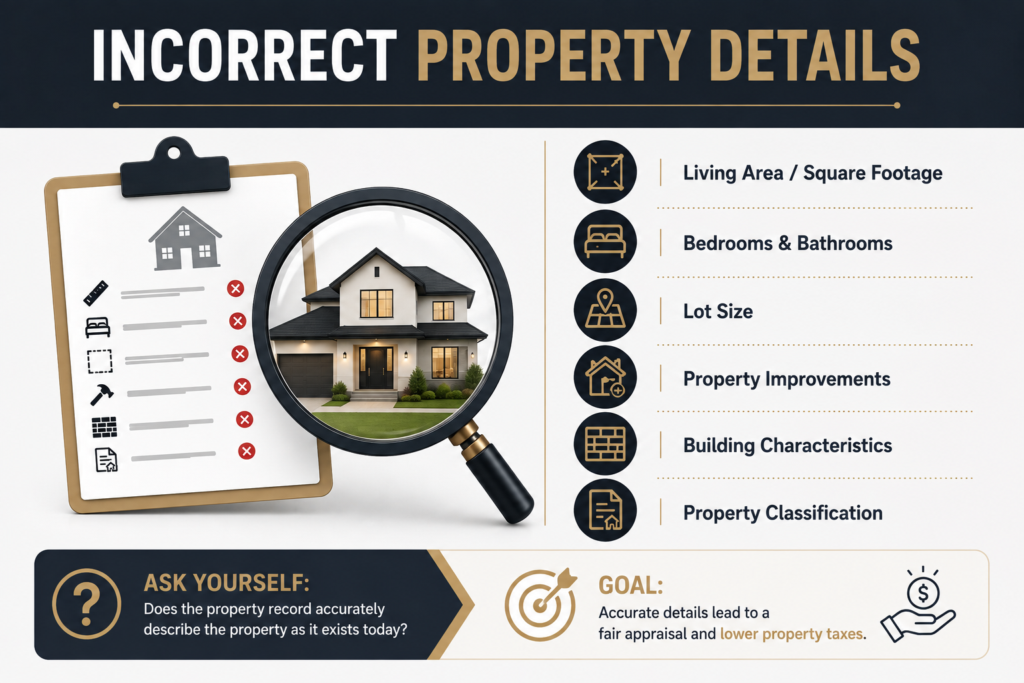
Incorrect Property Details
One of the simplest valuation problems starts with incorrect information about the property itself.
Appraisal records may include details such as:
- Living area or square footage
- Number of bedrooms and bathrooms
- Lot size
- Property improvements
- Building characteristics
- Property classification
If the information used to value a property does not accurately describe what is actually there, the resulting valuation may also be inaccurate.
For example, a record that lists more square footage than a property actually has could contribute to an inflated valuation.
Property owners should review their appraisal records and ask:
Does the property record accurately describe the property as it exists today?
If something is incorrect, documenting the discrepancy can be an important part of reviewing the property’s appraised value.
Overlooking the Condition of the Property
Not every property is in the same condition, even when two properties are located in the same neighborhood.
A property may have issues such as:
- Roof damage
- Foundation problems
- Water damage
- Outdated interiors
- Structural concerns
- Deferred maintenance
- Other physical deficiencies
If these conditions are not reflected when a property is valued, the appraisal may not tell the full story.
This is especially important when comparing a property that needs significant repairs with a similar property that has been recently renovated.
The question is not simply, “What are similar properties worth?”
It is also:
“Are those properties actually comparable to mine?”
Photos, repair estimates, inspection reports, and other documentation can help demonstrate differences in condition when reviewing an appraisal.
Using the Wrong Comparable Properties
Comparable properties, often called “comps,” can be useful when evaluating whether a property has been valued appropriately.
However, not every nearby property is a good comparison.
A meaningful comparison may need to consider factors such as:
- Location
- Property size
- Lot size
- Age
- Condition
- Construction characteristics
- Improvements
- Recent sales activity
A larger, renovated home should not automatically be treated as an appropriate comparison for a smaller property that requires substantial repairs.
The same principle applies to commercial properties. Differences in location, building characteristics, occupancy, income potential, and other factors can affect how useful a comparison is.
Using a few nearby properties without examining these differences may not provide a strong basis for challenging a valuation.
Failing to Account for Changes to the Property
Property records do not always tell the complete story of what has happened to a property over time.
A property may have undergone changes that affect its condition or value. Conversely, improvements or characteristics that are no longer present may still need to be reviewed in the appraisal record.
Property owners should consider:
- Were additions recorded correctly?
- Are removed structures still included?
- Does the property record reflect the current condition?
- Were improvements valued appropriately?
- Has the property’s use changed?
A careful review can sometimes reveal information that needs to be corrected or clarified.
Assuming the Appraised Value Must Be Correct
Receiving a Notice of Appraised Value does not mean the number cannot be questioned.
The notice provides information about the current year’s appraised value, the prior year’s value, exemptions, and the process for protesting the value.
Property owners have the right to protest an appraised value or unequal appraisal when they believe the property’s valuation is incorrect.
That does not mean every property should be protested.
Instead, property owners should first ask:
Does the appraised value appear reasonable based on the property’s characteristics, condition, and available market evidence?
If the answer is no, further review may be worthwhile.
Confusing Market Value, Assessed Value, and Taxable Value
Property tax records can contain several different values, and understanding the difference matters.
Market value represents what a property would likely sell for under certain market conditions. Assessed value may reflect applicable limitations, while taxable value accounts for exemptions and is used in determining the amount subject to property taxes.
These numbers are related, but they are not interchangeable.
A property owner reviewing a tax record should understand which value is being questioned and how exemptions or limitations affect the final taxable amount.

Ignoring Unequal Appraisal
A property may also be worth reviewing when its value is high compared with similar properties.
This is different from simply arguing that the property’s market value is too high.
For example, if similar properties are being valued at significantly lower levels despite having comparable characteristics, the issue may involve unequal appraisal.
Unequal appraisal is recognized as a reason for protesting a property valuation in Bexar County.
The important part is identifying genuinely comparable properties and understanding why the differences exist.
A property owner may find that simply locating properties with lower values is not enough. The comparisons should be relevant and supported by meaningful similarities.
Waiting Until the Deadline to Review the Value
Property owners often wait until the protest deadline is approaching before looking closely at their appraisal.
That can make the process more difficult.
Researching comparable properties, gathering photographs, checking property records, and organizing supporting documentation can take time.
For most property owners in Bexar County, the protest deadline is May 15 or 30 days after the appraisal notice was mailed, whichever is later.
Starting the review earlier provides more time to identify potential errors and prepare relevant evidence.
It also gives property owners more time to determine whether a formal protest makes sense for their situation.
What Should You Review Before Protesting?
Before deciding whether to protest, consider reviewing the following:
- Is the property description accurate?
- Is the square footage correct?
- Is the lot size correct?
- Are bedrooms and bathrooms listed accurately?
- Does the record reflect the property’s current condition?
- Are there documented repairs or physical issues?
- Are the comparable properties truly similar?
- Does the appraised value appear consistent with recent market activity?
- Are the appropriate exemptions reflected?
- Is there evidence of unequal appraisal?
The goal is not simply to argue that a property is worth less.
The goal is to understand why the assigned value may not accurately reflect the property.
Preparing Evidence for a Property Tax Protest
A stronger review usually starts with specific information rather than a general disagreement with the appraisal.
Depending on the property and the issue, useful documentation may include:
- Photographs
- Repair estimates
- Inspection reports
- Property records
- Relevant sales information
- Comparable property information
- Documentation showing incorrect property characteristics
The most useful evidence depends on the reason for the protest.
For business personal property, for example, supporting information may include fixed asset listings, acquisition information, disposal records, lease agreements, photographs, and inventory documentation.
Organizing evidence around the specific valuation issue can make the information easier to understand and evaluate.
When a Property Valuation Deserves a Closer Look
Not every increase in value is an error.
Property values can change because of market conditions, improvements, new construction, or other factors. The important question is whether the value assigned to your property is supported by accurate property information and appropriate evidence.
If something does not appear right, reviewing the valuation sooner rather than later can give you more time to understand the issue and determine whether a protest is appropriate.
For property owners who are unsure where to begin, Alamo Ad Valorem can help review the valuation, identify potential discrepancies, and provide guidance on the property tax protest process. The goal is not simply to challenge a value, but to make sure the information and evidence supporting that value are accurate and relevant.
Reviewing Your Bexar County Property Valuation
Property tax valuation can involve more than simply comparing this year’s number with last year’s number.
A careful review looks at the property record, physical condition, comparable properties, market information, exemptions, and the specific reason the valuation may be inaccurate.
Preparation does not guarantee a reduction in Bexar County property tax.
It does, however, give property owners a better opportunity to identify errors, organize relevant evidence, and make an informed decision about whether to protest.
If you believe your Bexar County property has been valued incorrectly, Alamo Ad Valorem can help you take a closer look at the valuation and understand whether a property tax protest may be appropriate. Starting early gives you more time to review the details, gather supporting information, and prepare before the applicable deadline.